Magic is a shift in perception
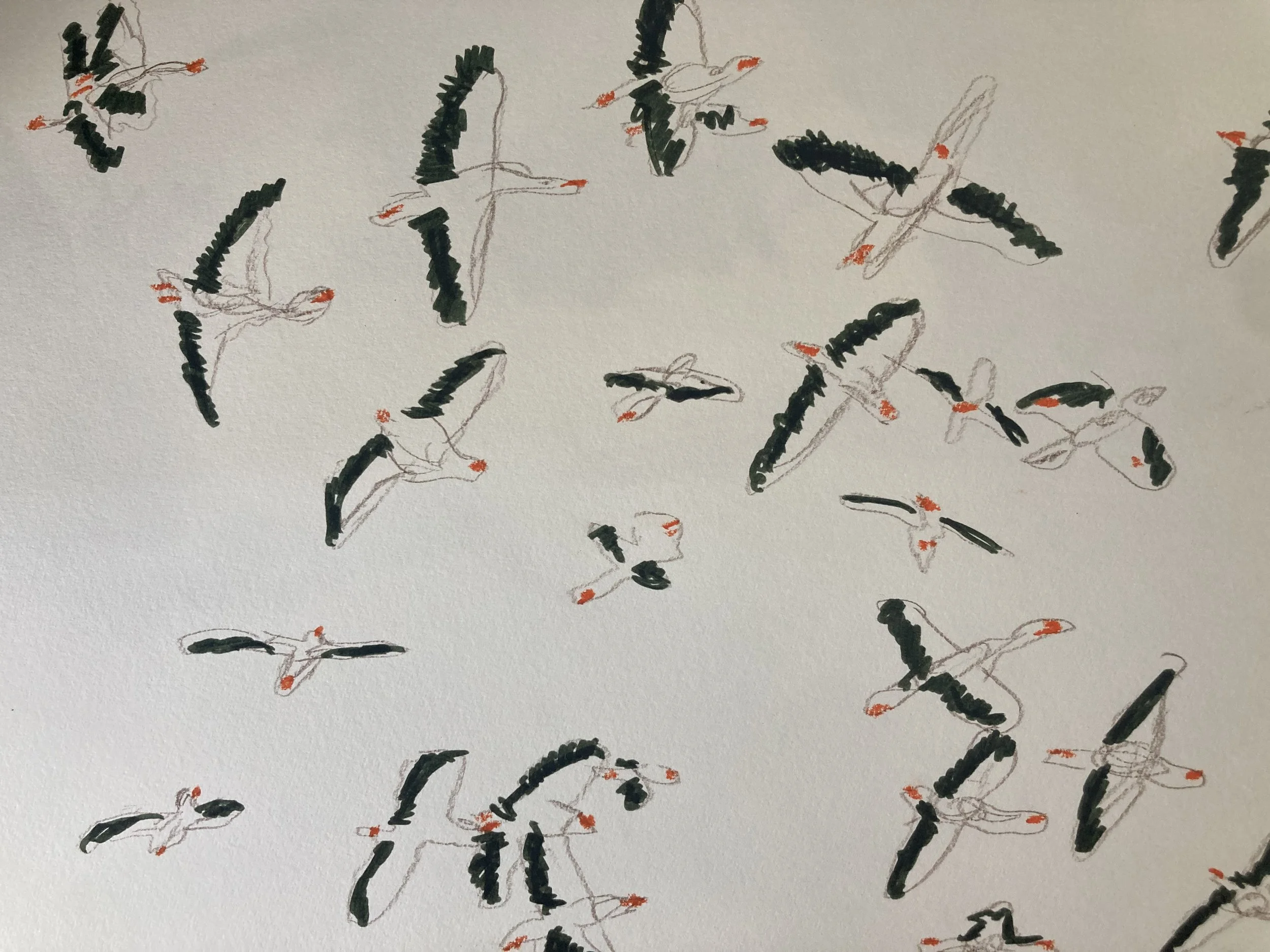
drawing: Dorothée King
(Adapted from my graduation speech 2026)
Let’s start with an art exaple: Tino Sehgal, an Indian-German performance artist, has spent the last twenty years creating what he calls “constructed situations,” in which performers, whom he refers to as “interpreters”, interact live and directly with museum visitors. Whether through engaged conversations or provoked pauses. An example could be sudden kisses in the exhibition space. These are moments of pause within otherwise predetermined scopes of actions
Tino Sehgal is an economist and dancer. In his constructed situations, he comments on capitalist conditions by refusing to create physical art objects. Instead, Tino Sehgal relies on social interaction. In doing so, he intentionally interrupts routines, prompting us to pause in our predetermined and learned behaviors, thereby opening up spaces for new thoughts and new actions.
And here comes another example about pausing you can try for yourself, a simple breathing exercise. Let’s do the 4-7-8 breathing exercise together.
To do this, inhale slowly through your nose while counting to four. Then hold your breath and count to seven. Next, exhale slowly while counting to eight. Repeat this three times.
Then reverse the breathing sequence. Now start with the exhale: Exhale: 1-2-3-4 .Hold: 1-2-3-4-5-6-7. Inhale: 1-2-3-4-5-6-7-8. Repeat this three times as well.
Taking a conscious break in your breathing rhythm is healthy because it calms the nervous system and reduces stress. In addition, breath pauses give us valuable insights. Do we prefer inhaling or exhaling? Which breath is more pleasant? And above all: Were we able to briefly interrupt the flow of our thoughts? Could we perceive the world around us in a new way? Form new thoughts?
Two quotes shall deepn our ability to pause:
The first quote is: "Between stimulus and response there is a space. In that space is our power to choose our response. In our response lies our growth and our freedom."
This quote is attributed to Victor Frankl. Victor Frankl, a Holocaust survivor, reflected in his 1946 book, “Man’s Search for Meaning”, written shortly after his imprisonment in a concentration camp, that it is often our reaction to events that makes us unhappy. He suggests that, in the moment before we react, we can reclaim our power and ability to take decisions. Victor Frankl wrote in English at that time because he could no longer bear the German language. Rather than to stop writing altogether, he paused briefly, switched languages, and reclaimed his own power of expression.
The second quote is: “Magic is a shift in perception.” These are words that my New York yoga teacher, Shannon Gannon, took from the “Book of Wonders”.
We live in a time when the volume of stimuli has become overwhelming. News, emails, social media, work demands, expectations, reports of crises, so many things seem to demand our immediate attention. We often feel we have to react right away: We reply to messages quickly, assuming we’ve freed up some time for ourselves, but the opposite happens. The adressee responds quickly as well. We write back and forth. Time passes. Stress levels rise. Nothing has been completed or resolved. Even in educational setting, we might think that reactionism and responseism are our go-to-solutions. But does that leave time and space for genuine encounter, for insight, for creativity, for sustainable change in the world?
Perhaps one of the most important skills of our time is to reclaim precisely this small space between stimulus and reaction, the space Victor Frankl spoke of in order to remain capable of action and transformation.
We need a space that gives us breathing room before we spring into action. A moment to catch our breath, just as we’ve just practiced. A pause in which we can ask ourselves questions before we react. Such questions might be:
What is really happening right now?
What am I actually perceiving - and what am I reading into it?
Are my former experiences influencing my perception?
I have options for responfing. What are they?
In this space, between stimulus and response, we can break free from repetition and frustration. We can moveforward towards being fully present in the magic of the moment, towards true connection and innovation.
Because often, and here I return to the second quote, “Magic is a shift in perception”, it is not our reaction that changes the world. Rather, it is our changed perception of the world that changes the world.
In our fast-paced, reactive world, we view the world through the lens of our experiences, conditioning, assumptions, judgments, prejudices, hopes, and fears.
The art of pausing begins with becoming aware of our own perspective. Then, in that moment, detached from our usual assumptions and preconceptions, we can look at the situation anew and reassess it. Giving ourselves space for a response, that is, a genuine reaction. That is the magic.
Ryushun Kusanagi received his education at one of Japan’s most renowned universities but ultimately chose to forge his own path. Rather than following a capitalist career trajectory, he chose the path of pausing and became a monk. His Buddhist message isn’t new, but it sums up what we’ve just reflected on quite well:
“Suffering arises not only from external events but also from our reflexive reactions to them. A brief pause breaks this cycle of automatic chain reactions and neutralizes negative emotions by objectively naming what is really going on. By breaking the cycle of assumptions, projections, judgments, and reactions, we free up the energy to truly perceive the moment. This ultimately conserves our valuable mental energy and creates space for actions that are truly meaningful.”
Back to art and design education:
My argument: When we combine the skill of pausing with art and design education, the result is both productive and magical.
The book *Your Brain on Art*, written in 2012 by Susan Magsamen and Ivy Ross, has just made it onto the bestseller lists. Drawing on neuroscientific findings, it explains why art is important to people. The book demonstrates that art is neither decoration nor entertainment. Art is a fundamental human ability to regenerate, train our attention, respond mindfully, and act purposefully in this world. In the field of neuroaesthetics, the authors examine how sound, images, installations, performances, and storytelling influence our brains.
When we engage with, participate in, or initiate design and art projects, something happens. We become attentive. We slow down. We experience concentration. We link feelings to our thoughts. New perspectives become possible.
Arts and Design Education is a highly complex discipline that draws from a wide variety of fields. It teaches us to tolerate different perspectives. We specialize in listening, observing, and paying attention to one another. Let’s add some questions to the pauses we create that benefit us and the others:
What can’t I see yet?
What can I learn from you, my fellow human being?
What happens when I dare to let go of my own perspective for a moment?
What happens when I am truly present for myself and for the other person? With all the contradictions, pain, and offbeat ideas that artistic processes can bring forth?
How can I truly listen and not just wait to speak again myself?
How can I simply pause and accept that I don’t yet know what comes next?